- 2015-08-03: New in 0.12.0-SNAPSHOT
- 2015-03-11: ZVTM v0.11.2 released
- 2013-08-19: ZVTM v0.11.1 released
Current Version
Stable: 0.11.2 (March 2015)
Development: 0.12.0-SNAPSHOT through SVN and Maven only (July 2015)
What is ZVTM ?
Current Graphical User Interface toolkits like Swing are powerful, generic and portable, but cannot be used for some generic application classes such as graph editors, requiring programmers to use lower-level APIs such as Java2D which are more expressive but harder to use.
ZVTM is a Zoomable User Interface (ZUI) toolkit implemented in Java, designed to ease the task of creating complex visual editors in which large amounts of objects have to be displayed, or which contain complex geometrical shapes that need to be animated. It is based on the metaphor of universes that can be observed through smart movable/zoomable cameras, and offers features such as perceptual continuity in object animations and camera movements, which should make the end-user's overall experience more pleasing.
ZVTM features a graphical object model that makes the task of creating, modifying and animating graphical entities easier, allows the definition of custom shapes, all through a simple API. ZVTM also features smooth zooming capabilities (zoomable user interface), multiple independent layers inside a single viewport. In addition to vector graphics, text and bitmap images, ZVTM can display PDF documents and supports a subset of SVG. It has been used for instance to develop IsaViz, a visual browser/editor for RDF that represents models as zoomable 2D graphs.
ZVTM is the continuation of a project initiated at Xerox Research Centre Europe and later continued at MIT and W3C. It was then called XVTM (Xerox Visual Transformation Machine). ZVTM, now developed at INRIA, builds upon XVTM and is distributed under the LGPL license as was XVTM.
Main Features
ZVTM is able to manage a large amount of objects efficiently.
The underlying model is based on the metaphor of universes that can be observed through smart movable/zoomable cameras. Such paradigms:
are useful because they simplify the construction and layout(infinite universes called virtual spaces)
are powerful because they allow to maintain a good perception of the context (smooth and continuous motion/zoom).
Objects are defined by visual attributes such as position, size, orientation, shape and color. When the programmer modifies the values of visual attributes, graphical representations are automatically updated (the programmer does not have to worry about the various painting/updating operations).
ZVTM features advanced but easy-to-use animation capabilities: each visual attribute modification can be animated through various temporal schemes (using Sun's Timing Framework since version 0.10.0).
ZVTM provides support for multi-layered views and object translucency (alpha channel). Objects can be seen through several views simultaneously.
Different types of magnification lenses (Sigma Lenses) can be activatted in views, thus enabling various focus + context representations.
Some applications using ZVTM
 |
 |
 |
 |
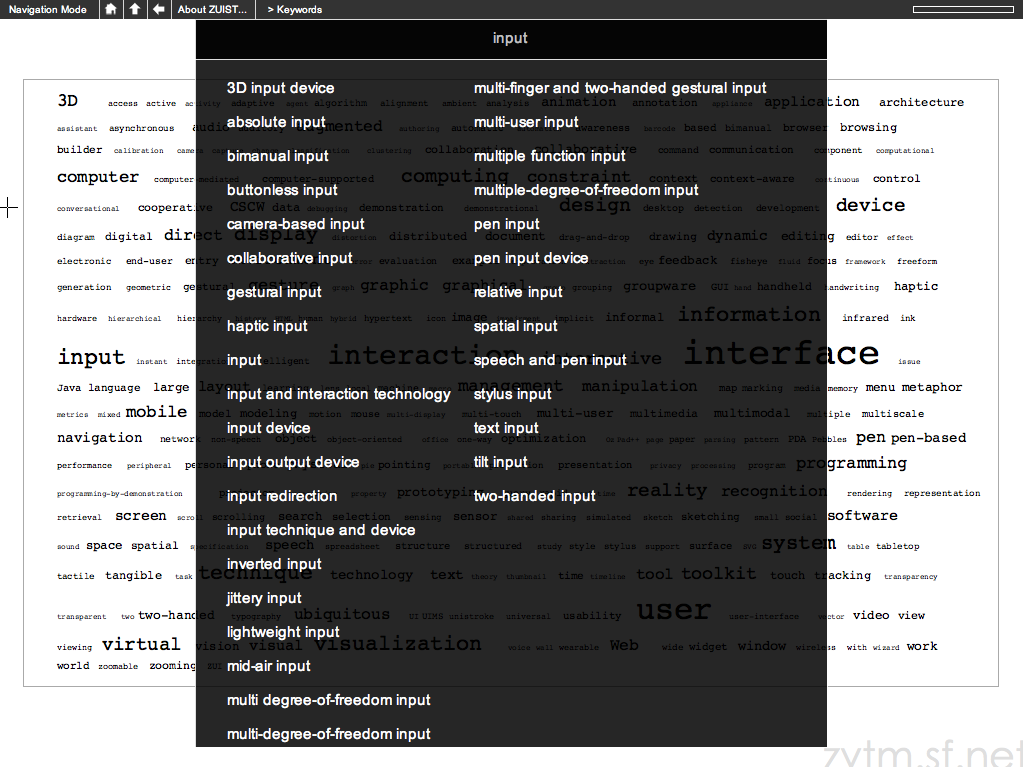
| World Browser | IsaViz | ALMA OMC | |
| Navigating in a multi-scale version of NASA's Blue Marble Next Generation World Map with Geonames data and ESRI shapefiles overlaid on top of it. A probing lens magnifies Massachusetts in context. |
Air traffic network of the main 232 airports and 690 heaviest routes on the same map (86 400 x 43 200 pixels decomposed into a pyramid of 2 730 tiles 1 350 x 1 350 each) |
A visual authoring tool for Semantic Web data (RDF) |
ALMA radio-telescope Operations Monitoring and Control software |
 |
 |
 |
 |
| ZGRViewer | UIST Explorer | BLAST2GO | VXT |
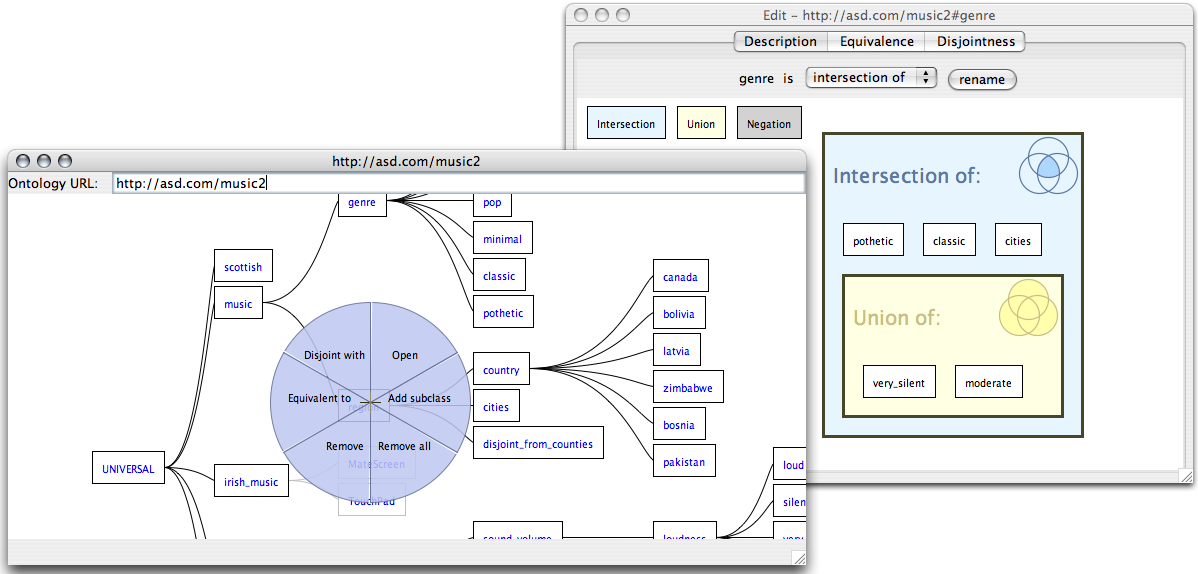
| A GraphViz/DOT viewer featuring many aids to navigation in large networks. | A multi-scale interface for navigating in 20 years of papers published at ACM UIST (578 PDF documents, typically 4-to-10 page long) | A universal Gene Ontology annotation, visualization and analysis tool for functional genomics research | A tool for visualizing and editing XML transformation rules (based on XSLT) |
 |
 |
 |
 |
| SOM | SALI Viewer | FST Visualizer | CLF/Panoramix |
| A P2P OWL ontology visual authoring tool | Structure Activity Landscape Index | A state-machine visualizer | A monitoring tool for distributed applications based on the CLF middleware platform |


